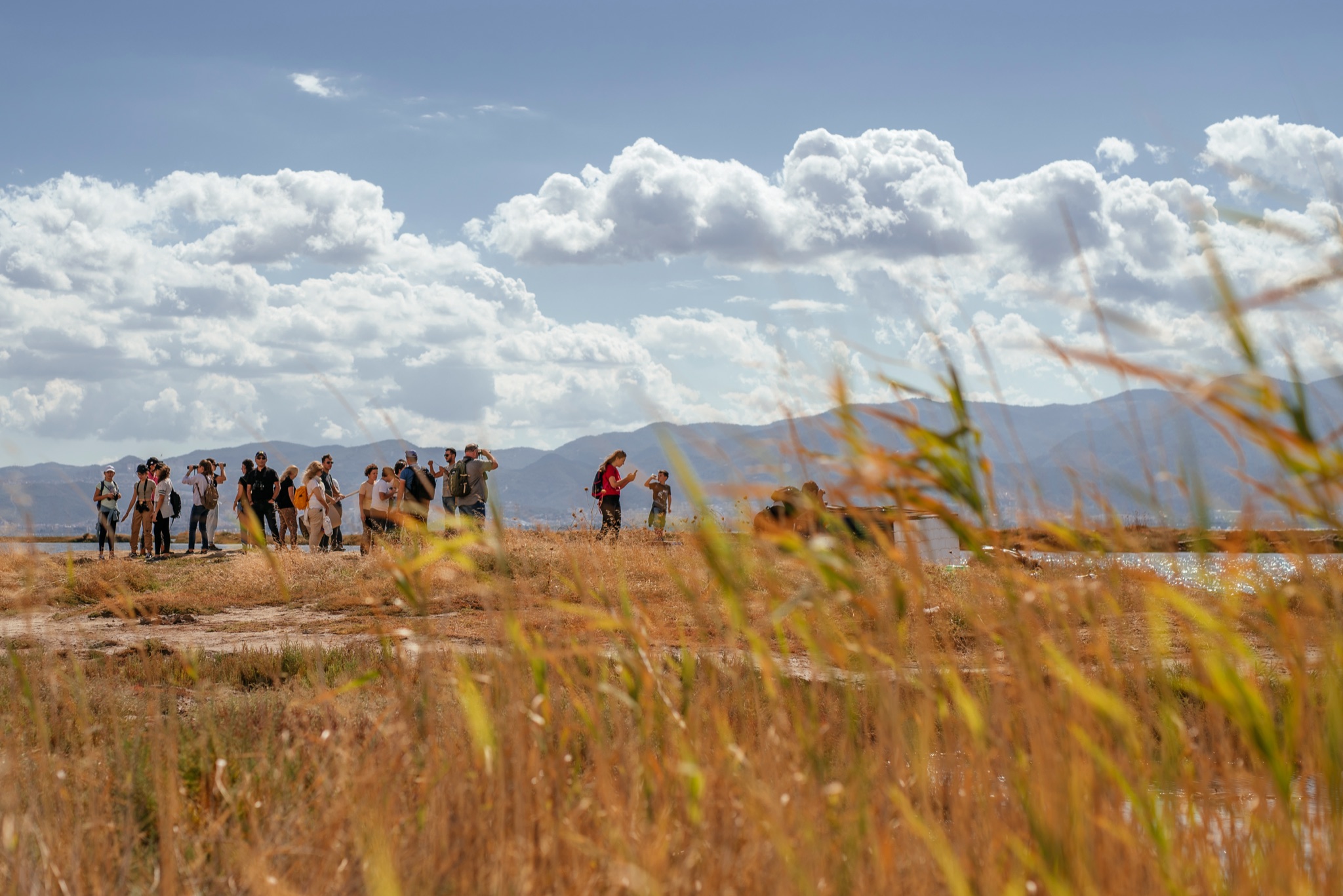
This text was written in the hope of explaining birdwatching, promoting it, and answering the questions that those curious about birdwatching might have. Contrary to popular belief, you don’t need a lot of equipment to go birdwatching. To get started, all you need is a pair of binoculars, a notebook, and a field guide.
Basic Equipment
Binoculars: Before using binoculars, you need to adjust the interpupillary distance to match the distance between your eyes. When you go out to observe, it’s helpful to adjust the eyepieces separately to balance your vision. To do this, cover the right eyepiece with your hand and look through the left eyepiece with only your left eye, using the central focus ring to focus on a distinct object that’s a little ways off. Then, making the same adjustments for the right eyepiece allows you to properly adjust the binoculars to your vision. By noting the markings on the edges of the eyepieces, you can record this setting for future observations, as it is the configuration that suits your eyes.
Some birdwatchers wear eyeglasses. Many binoculars feature a section called an “eyecup” for birdwatchers who wear glasses. Choosing binoculars with foldable rubber eyecups will be beneficial for you. Some birdwatchers may prefer to remove their eyeglasses while using binoculars because the field of view narrows slightly when the eyecups are in use. In such cases, there is a risk of losing sight of the birds during the brief moment it takes to put on or take off your eyeglasses to use the binoculars. If possible, keep your elbows—or your knees if you’re crouching—close to your chest; rest your elbows on any nearby support if available, or place the binoculars on a stable surface to steady them. This will help reduce the shaking of your binoculars to some extent. When trying to spot a bird, it’s helpful to first look with the naked eye at prominent landmarks nearby before looking through the binoculars. The ability to spot birds with binoculars improves with practice. You can ask experienced birders for help with this.

Field guide: The best way to learn about birds is directly with our own eyes. However, a field guide can make the learning process easier for you. Field guides offer the opportunity to instantly verify the birds we see in the field. A field guide containing explanatory information—especially regarding species that can be easily confused with one another—can serve as an excellent reference source for all birdwatchers. In addition, birdwatchers who wish to gain more detailed information on specific bird groups can find specialized, more detailed field guides—in foreign languages or online—focused on the groups they’re interested in. For more detailed information on field guides, you can consult the Nature Association or a birdwatching group near you.
Notebook: Among birdwatchers, a notebook is generally not a very popular tool. However, having a notebook with you during observations can be quite convenient. There are several reasons to keep a notebook. These include remembering the areas we visit, recording details that will help us recall the day of the observation, noting the birds we see, and preserving these records both for our own archives and to share with other birdwatchers. During an observation, we first write down details such as the observation site, date, time, and participants in the notebook. Then, we note the species seen throughout the observation and the numbers of each species. We can also write down in detail any bird we see for the first time or any sound we hear. This helps us in the learning process and makes it easier to describe birds we cannot identify to other observers. If information about various bird behaviors can be gathered during the observation (such as breeding behavior, carrying nest materials, etc.), these details can also be recorded in the notebook.
eKuşBank: You can support bird conservation efforts by recording your observations in eKuşBank, a shared database for birdwatchers worldwide. You can visit the site on your computer, or download the app to your phone to add your observation records directly to the eKuşBank database.
To visit the site: ekusbank.org
Telescope: One of the most important considerations when using a telescope is adjusting its height to suit the observer. On many field trips, you may notice observers leaning over the telescope to look through it. This is generally due to telescopes being shared among multiple people and the telescope’s height being adjusted to accommodate the shortest person. Leaning over the telescope is not only dangerous for your back but also makes birdwatching more difficult. When using a telescope, you can use a tripod or other supports. Otherwise, the image you see may be shaky.
Especially when observing small but active birds, switching quickly from binoculars to a telescope will make your observation easier. Since your viewing time may be very short, you can start by using binoculars. To use the telescope more quickly, you can carry it mounted on a tripod. While doing so, either balance the tripod on your shoulder or sling it over your shoulder using a strap attached to one end of the center column. When you sling the tripod over your shoulder, make sure the telescope is positioned in front of your body. This way, you’ll prevent the telescope from receiving unwanted impacts and damage. Conducting systematic sweeps with a telescope mounted on a tripod is the most preferred method of using a telescope. While scanning, shifting the image in the eyepiece sideways by the width of the telescope is an ideal method for ensuring that all nearby birds are visible. During observation, carefully determine the location of the bird you’ll be watching, taking into account the details of the terrain. You can use one hand to adjust the focus.
Clothing: As with many outdoor activities, one of the keys to enjoying birdwatching comfortably is wearing the right clothes at the right time. Feeling too cold or too hot can be uncomfortable and may prevent you from focusing on the birds. In addition, the colors of your clothing may cause the birds to spot you before you see them. Dressing appropriately is very important for fieldwork. So, what should you look for in clothing?
- It should keep you warm,
- It should be lightweight,
- It shouldn’t get damp easily,
- It should dry quickly when wet,
- It should allow sweat vapor to escape,
- It should be waterproof and windproof (outerwear).
Another point to consider for appropriate clothing is the properties of the main materials used in the garments. When choosing clothing, synthetic fabrics (such as fleece) and woolen garments should be preferred whenever possible. In the winter months, thick fabrics like velvet can be chosen for pants. Jeans should be avoided, especially in cold and rainy weather. On warm days, choosing lightweight and comfortable fabrics will keep you comfortable.
The head and neck are the areas where the body loses the most heat. For this reason, it’s important to wear a hat and scarf during the winter months. Keeping our feet warm and dry not only prevents us from getting sick but also enhances our enjoyment throughout the trip. On hikes, you should choose long socks that won’t make you sweat, and if possible, carry a spare pair with you. Similarly, on hot summer days, you must also protect these areas of your body. Choosing the right footwear is one of the most important considerations for birdwatchers. As the terrain becomes steeper, wearing shoes with sturdy soles will increase comfort and safety. Shoes with the following features are recommended for fieldwork:
- Ankle support is important for foot health. This helps prevent ankle sprains.
- Waterproofing makes it easier to protect your feet.
- Sturdy laces that hold a secure knot allow for ease of movement.
- Your toes should be able to move comfortably inside the shoe.
Backpack: One of the most important pieces of equipment for birdwatchers is a backpack. Carrying the weight we bring on our trips on our backs is the most comfortable and healthy way. The shoulder straps help distribute some of the load and keep the backpack balanced. We carry the main weight on our lower back thanks to the waist belt. Backpacks made of water-resistant and durable fabrics help protect our belongings.

Behavior: How should we behave during birdwatching, and what should we pay attention to? We can actually break the answer to this question down into two parts: things we should avoid doing to prevent disturbing birds and other wildlife, and things we should do to observe birds as effectively as possible.
A birdwatcher:
- First and foremost, respects the birds’ right to life,
- Helps protect Important Bird Areas (IBAs) and their habitats,
- Avoids all activities that would stress or endanger birds,
- Does not use methods to attract birds (such as sounds or recordings),
- Stays away from sensitive areas such as breeding colonies and roosting sites, and warns other birdwatchers not to enter these areas,
- When discovering the breeding sites of rare and endangered birds, does not disclose this confidential information but informs the relevant individuals and institutions after taking appropriate measures,
- To avoid damaging the natural habitat, they stay as close as possible to roads and trails,
- They do not disturb other living creatures and make it a principle to show them respect (such as refraining from collecting anything from nature),
- During group observations, they respect the rights of other birdwatchers,
- During group observations, they do not break the rule of silence and disturb wildlife as little as possible. They caution other observers who cause disturbances and provide information about birdwatching principles.
- Shares knowledge with new birdwatchers and strives to observe while fostering relationships based on goodwill.
Speech: Remain as quiet as possible in the field; this allows you to focus your attention on the birds and ensures you do not disturb them.
Approaching birds: Be careful as you move toward birds, and avoid sudden movements. Do not get unnecessarily close to any living creature in nature. This frightens them and causes them to become stressed, leading them to abandon their habitats. If you are in a place where birds can easily see you, avoid making sudden movements; do not stop abruptly while walking. This can startle the birds.
Habitats: Visit as many different types of habitats as possible in the area where you are. If a stream or river runs near the path you’re walking on during birdwatching, be sure to check it out. Remember that different habitats, such as stream banks, may host a wider variety of species. Different habitats—such as gardens, farmlands, poplar groves, and thickets—provide living spaces for different bird species. The more diverse habitats you visit during a single observation, the more different bird species you’ll be able to see.
Light: Pay attention to the direction of the light when planning your route. Lighting conditions are especially important for excursions in wetlands. If you’re observing against the light, you may only see the silhouettes of birds on the water’s surface.
Using Our Senses: How well do we use our senses? How aware are we of our surroundings? When we enter an unfamiliar environment, what do we pay attention to, and how open are our senses? Of course, we don’t need all our senses for birdwatching. But we need to use two of them—sight and hearing—more intensely during our observations.

Using Our Eyes: During walks, beginner birdwatchers generally tend to look down at the ground and straight ahead. On the contrary, it’s important to constantly scan your surroundings while walking and focus more on your surroundings than on the ground beneath your feet. How you use your eyes also varies depending on the characteristics of the habitat you’re in. In a wooded area, you’ll focus more on monitoring movement among the tree branches, while in open areas, constantly scanning the sky and the horizon gives you the best chance of spotting birds in the area. Don’t forget that many birds fly silently overhead. Birdwatchers who constantly scan the sky may spot predatory bird species. Regularly checking areas where birds are likely to be found also increases the number of birds you’ll see.
Using our ears: We can listen to all the birds around us and try to identify every bird we hear by its call. If you hear a bird call you don’t recognize, jot it down in your notebook; you can discuss it with fellow birders during your observation or use apps to listen to recordings and get an idea of what species it might be. You can hear bird calls everywhere. Pay attention to bird calls on your way to school or work. Learning to recognize the calls starts slowly, but eventually you’ll begin to discern the differences between them. The initial effort you put into this is crucial.
Birds and their behavior: Knowing and learning which birds inhabit specific habitats changes our perspective. Now our eyes search for warblers walking or feeding among the lower parts of the vegetation in marshy areas, while our ears listen for the movements and communication calls of warblers in scrubland regions. In wooded areas, we look for tree creepers and nuthatches on tree trunks, and in farmlands, we listen for the calls of Eurasian skylark. Along with these, our observation techniques change depending on the species we’ll be seeing. For example, patiently and motionlessly waiting for warblers to emerge from the thickets, or moving slightly away from the trees where blackcaps are perched to observe them. These methods, which you’ll develop over time, are closely linked to your awareness and level of attention. The more attention you pay to the birds’ behaviors and characteristics, the easier your future observations will become.
Practice: No matter what you do to become a good birdwatcher, it will be difficult to achieve your goal unless you get out into the field regularly. There are two ways to practice. The first is simply to go on regular field trips; the second is to conduct most of these regular trips in the same area. Both methods will increase your knowledge of birds, but the second method is always preferred for self-improvement. Regular year-round observations in a specific area reinforce your understanding of the relationship between birds and their habitats and provide you with more information about which seasons the birds are seen in.
If possible, start by identifying a location in your area that’s easy to access and where you can go regularly. Record your observations in this area once a week (though the number of observations can certainly increase). As long as you continue your regular observations, you’ll notice that you’re making a little more progress each week, and as the seasons change, you’ll also notice changes in the birds. Regular observations give you the opportunity to recognize bird calls better and hear the same calls repeated consistently. Since the bird sounds in your environment won’t change all at once but will evolve over time as new birds arrive, this will help you learn the sounds slowly but steadily.
Health and Safety: One of the key issues birdwatchers must be mindful of in the field is health and safety. We must never forget that prevention is the most important factor. The following points may be helpful for birdwatchers who are just starting out:
- Make sure to eat a sufficient and balanced diet during your observation. Don’t forget to drink water on your birdwatching trips.
- If you’re camping, be sure to check your equipment.
- While scanning for birds, also pay attention to where you’re stepping.
- Do not venture alone into marshes or areas you know to be hazardous.
- Never venture out onto a lake in a rowboat or boat if you’re unsure of the conditions.
- Do not drive your vehicle through muddy areas where you are unsure of the conditions.
- When you go birdwatching, don’t forget to bring along any special phone numbers you might need in the area you’re visiting.
When buying binoculars: Certain optical features are preferable in binoculars intended for birdwatching. These include:
- They should provide a clear image in low light
- The magnification should be sufficient
- The field of view should be sufficiently wide
Recommended: 8×40 specifications are sufficient and optimal for birdwatching. Although 8x binoculars make birds appear slightly smaller, they are preferred by birdwatchers.
For detailed information on birdwatching:
Şafak Arslan
0 507 346 09 14
[email protected]